MOGADISHU, Somalia – The United Nations Transitional Assistance Mission in Somalia (UNTMIS) will formally end its operations on October 31, completing a two-year transition process that will transfer its responsibilities to Somali government institutions and other UN agencies.
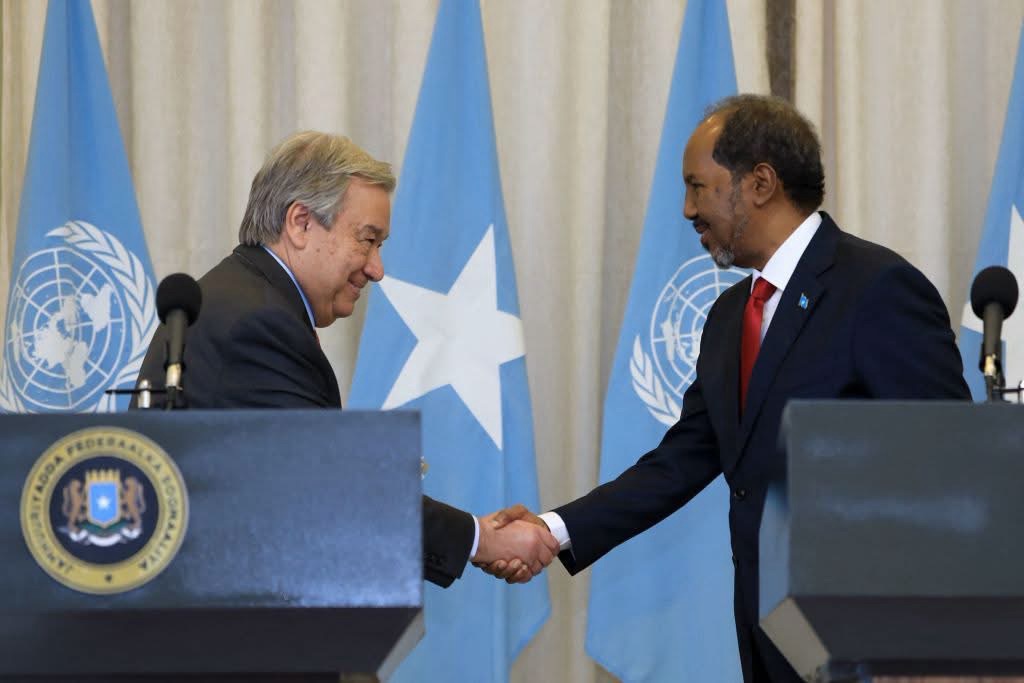
UN Secretary-General António Guterres announced the development in a statement issued through his spokesperson, describing the closure as an important milestone in Somalia’s efforts to assume greater responsibility for its peacebuilding and state-building agenda.
The decision follows a request by the Federal Government of Somalia and United Nations Security Council resolutions 2753 (2024) and 2809 (2025).
Under a transition roadmap jointly agreed by the Somali government and the United Nations, the mission’s mandated responsibilities have been transferred to Somali institutions and the UN’s resident agencies, funds and programmes.
Guterres commended the progress Somalia has made towards peace and security, praising the resilience of its population despite continuing political, security, humanitarian and development challenges.
He said the United Nations would maintain its engagement with Somalia through its agencies and programmes, working alongside government institutions, the African Union and international partners to support peace, stability, human rights and sustainable development.
The Secretary-General also called on the international community to maintain its support for Somalia, particularly in strengthening government institutions, advancing political dialogue and reconciliation, and supporting a gradual and sustainable security transition.
A shift in the UN’s role in Somalia
The closure of UNTMIS marks the end of more than three decades of United Nations political missions in Somalia.
Its predecessor, the United Nations Assistance Mission in Somalia (UNSOM), began operations in 2013, following years of international engagement in the country’s efforts to rebuild state institutions after decades of conflict.
UNTMIS was established on November 1, 2024, as part of a two-year transition towards transferring the mission’s responsibilities to Somali institutions and the wider UN system.
The Federal Government requested the transition in 2024, seeking greater national ownership of the country’s political and institutional development.
The end of the mission does not, however, mean the United Nations is withdrawing from Somalia. Its development, humanitarian and other programmes will continue through its agencies operating in the country.
Questions over institutional capacity
The transition places greater responsibility on Somali institutions to sustain areas previously supported by the political mission, including governance, human rights, reconciliation, the rule of law and political dialogue.
The Secretary-General’s call for continued international assistance also highlights the challenges that remain as Somalia takes on a greater role in managing its own peacebuilding and state-building priorities.
Security remains a significant concern, particularly the continuing threat posed by al-Shabab, while political disagreements and institutional capacity will remain important factors in the country’s transition.
As UNTMIS prepares to conclude its mandate, the effectiveness of the handover will depend partly on the ability of Somali institutions to maintain the work undertaken during the mission’s presence.
For Somalia, October 31 marks not the end of its partnership with the United Nations, but a change in how that partnership is organised, with greater responsibility expected to rest with national institutions.