OPINION & POLITICAL ANALYSIS | THE SOMALI
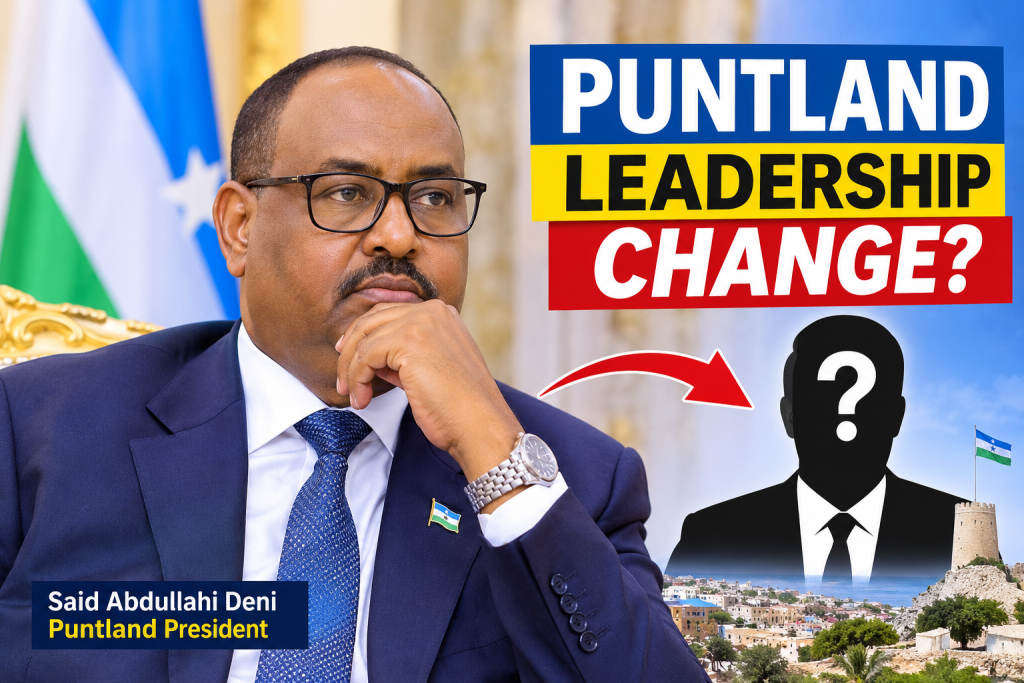
Somalia’s struggle to rebuild a functioning state is being complicated by a political confrontation between Mogadishu and Garowe. At the centre of this dispute is Puntland President Said Abdullahi Deni, whose administration has increasingly challenged the authority, legitimacy and institutions of the Federal Government of Somalia.
But an important distinction must be made: Puntland’s people are not Somalia’s problem. The political decisions of their regional leadership are.
The people of Puntland are part of the Somali nation. Their history, identity and future are inseparable from Somalia. The region’s establishment as an autonomous administration in 1998 was not a declaration of independence. It was an attempt to establish regional self-government within a united Somali state.
The political crisis unfolding today should therefore not be interpreted as a confrontation between Puntland and Somalia’s national population. It is fundamentally a dispute over political leadership, constitutional authority and the future direction of the Somali state.
A regional leadership challenging national authority
Under President Said Abdullahi Deni, Puntland’s relationship with Mogadishu has deteriorated into an increasingly serious institutional confrontation.
In March 2024, Puntland withdrew recognition of federal government institutions following disagreements over constitutional amendments. Since then, the administration has repeatedly announced its intention to operate independently of federal decisions.
In June 2026, Deni stated that Puntland would independently manage its resources and international agreements until a consensus-based federal government was established.
On 20 November 2026, Puntland announced another suspension of cooperation with Mogadishu, covering constitutional review, federal elections and national security. It also declared that it would not recognise new federal laws pending an agreed constitutional framework.
These are not insignificant administrative disagreements. They concern the fundamental relationship between a regional government and the sovereign state of which it forms part.
Puntland has the right to challenge federal decisions, demand consultation and defend its constitutional interests. However, there is a fundamental difference between opposing particular government policies and systematically weakening the authority of national institutions.
The consequences of the latter extend beyond the current political leadership in Mogadishu. They affect Somalia’s ability to function as a sovereign country.
The people must not be confused with their president
One of the greatest risks in the current political debate is the tendency to associate the actions of Puntland’s administration with the political aspirations of its entire population.
That would be a mistake.
Puntland’s residents should not be collectively held responsible for decisions made by their regional president and administration. Nor should political disagreements between Garowe and Mogadishu be allowed to create divisions between Somali communities.
The people of Puntland have a legitimate interest in a stable, united Somalia in which their region enjoys meaningful political representation, security, economic opportunities and constitutional protections.
The question is whether the current regional political leadership is advancing those interests through constructive federal engagement or through continued confrontation.
A regional president is entrusted with governing on behalf of the population, not with treating national institutions as political opponents.
The distinction between Puntland and its current administration must remain central to any serious discussion about resolving the crisis.
The politics of weakening federal institutions
Somalia’s federal system was established to reconcile regional autonomy with national unity.
However, federalism cannot function if individual administrations claim the benefits of national membership while rejecting national institutions whenever political disagreements arise.
The recent suspension of cooperation illustrates this contradiction.
National security, constitutional development, electoral arrangements and international representation require functioning relationships between the federal government and regional administrations.
When those relationships collapse, the result is institutional fragmentation.
The danger is particularly serious when regional leaders seek separate international relationships that could bypass the national government in matters involving sovereignty, security and foreign policy.
Somalia cannot establish a credible national position internationally if its regional administrations pursue competing political arrangements without an agreed constitutional framework.
This is not an argument against Puntland’s autonomy. It is an argument for making regional autonomy compatible with a functioning national state.
The way forward: Political accountability and leadership renewal
Resolving the Puntland question requires recognising that the current political confrontation cannot continue indefinitely.
A central issue for Puntland’s political future is leadership accountability.
The regional population should have the opportunity, through credible, peaceful and constitutional political processes, to determine whether its current administration adequately represents its interests and its relationship with the wider Somali nation.
Leadership renewal is therefore an important issue in the debate about restoring constructive relations between Puntland and Mogadishu.
Any change must come through legitimate political and electoral mechanisms, not violence, coercion or external intervention.
The objective should be to establish regional leadership capable of defending Puntland’s constitutional interests while actively participating in the reconstruction of Somalia’s national institutions.
Puntland needs political leadership that can negotiate with Mogadishu without treating cooperation as a concession and defend regional autonomy without undermining national sovereignty.
Somalia also needs a stronger Federal Government
The Puntland crisis exposes a wider weakness in Somalia’s state-building project: the limited authority and institutional capacity of the Federal Government.
A functioning federal state requires a national government with sufficient constitutional authority to exercise its responsibilities.
Somalia needs stronger federal institutions capable of coordinating national security, representing the country internationally, implementing national legislation within constitutional powers and ensuring that federal member states operate within an agreed national framework.
Strengthening Mogadishu does not have to mean eliminating regional autonomy.
The objective should be a clearer and more effective division of responsibilities between the federal government and federal member states.
National defence, foreign affairs, citizenship, national sovereignty and the country’s international representation require coherent national institutions. Regional administrations should retain meaningful powers over their constitutionally assigned responsibilities.
The federal government must also be accountable, inclusive and respectful of constitutional limits. Greater federal authority cannot become an excuse for unilateral decision-making or the concentration of power in the presidency.
A stronger Somalia requires both an effective national government and responsible regional administrations.
The international community must support Somalia’s national institutions
International partners also have an important responsibility.
Engagement with Puntland and other federal member states is necessary for development, humanitarian assistance and security cooperation. However, international engagement should reinforce Somalia’s constitutional order rather than deepen institutional divisions.
Foreign governments and development partners should support dialogue between the federal government and regional administrations, encourage transparent agreements and respect Somalia’s sovereignty.
They should avoid allowing political competition between regional and national authorities to create parallel systems of international representation and security cooperation.
Somalia’s sovereignty must remain a national responsibility.
A united Somalia requires a change in political direction
The current confrontation between Puntland and Mogadishu is about much more than a disagreement over constitutional amendments or the next election.
It raises a fundamental question about what kind of country Somalia intends to become.
Will Somalia develop into a functioning federal state with effective national institutions, constitutional regional autonomy and a shared national identity? Or will it remain a fragmented political system in which regional administrations and national leaders compete for authority at the expense of state-building?
Puntland’s people should not be placed on the opposite side of this debate from the rest of Somalia. Their regional identity and political interests can coexist with their Somali national identity.
The challenge is to ensure that political leadership reflects that reality.
The debate over Puntland’s future must therefore include two interconnected questions: whether the region’s political leadership can restore constructive relations with the federal government, and whether Somalia’s national institutions can acquire the authority and capacity necessary to govern effectively.
Leadership accountability in Puntland and the strengthening of Somalia’s Federal Government are central proposals in this debate. Both must be pursued through constitutional, democratic and inclusive processes.
Somalia’s future cannot depend on the political interests of individual regional presidents. It must be built around institutions, national sovereignty and the collective interests of its people.
Puntland belongs to Somalia. Its people should never be confused with the political decisions of those who govern them.