A new global survey places Somalia ahead of several countries in Europe and Africa in perceptions of personal safety, although significant parts of the country were excluded from the research because of insecurity.
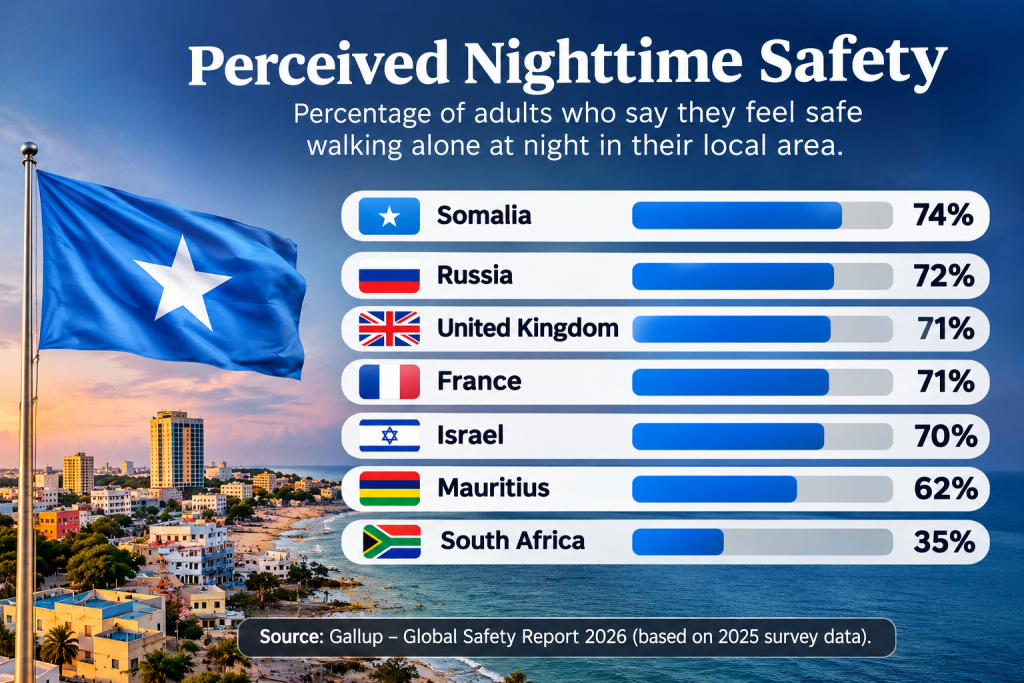
Somalia has recorded the highest level of perceived nighttime safety in sub-Saharan Africa, with 74 percent of surveyed residents saying they feel safe walking alone at night in the area where they live, according to Gallup’s 2026 Global Safety Report.
The findings place Somalia above several countries often associated with greater stability, including Mauritius, South Africa and Botswana, while also recording a higher percentage than the United Kingdom and France.
The report, released on November 17, draws on Gallup World Poll interviews conducted in 2025 across 140 countries and territories. It examines people’s perceptions of personal safety and everyday security amid continuing global conflicts and security challenges.
Somalia leads regional rankings
Somalia’s 74 percent result was the highest recorded in sub-Saharan Africa, followed by Tanzania at 72 percent and Mali at 70 percent.
Comoros and Niger each recorded 68 percent, while Ethiopia registered 64 percent. Mauritius recorded 62 percent, Ghana 61 percent and Nigeria 60 percent.
Kenya recorded 50 percent, while South Africa stood at 35 percent. Botswana recorded the lowest level of perceived nighttime safety globally, at 28 percent.
The results highlight significant differences in how people experience personal security across the continent, including between countries facing conflict and those generally considered politically stable.
Somalia’s results compared with Western countries
The survey also produced striking international comparisons.
Somalia’s 74 percent result was higher than the United Kingdom and France, both of which recorded 71 percent. Russia recorded 72 percent, Israel 70 percent and Australia 64 percent.
The United States recorded 78 percent, while China registered 74 percent.
However, the survey measures how respondents perceive their personal safety in their own communities. It does not establish that Somalia has lower crime rates or fewer security threats than the countries it outperformed.
What exactly did Gallup measure?
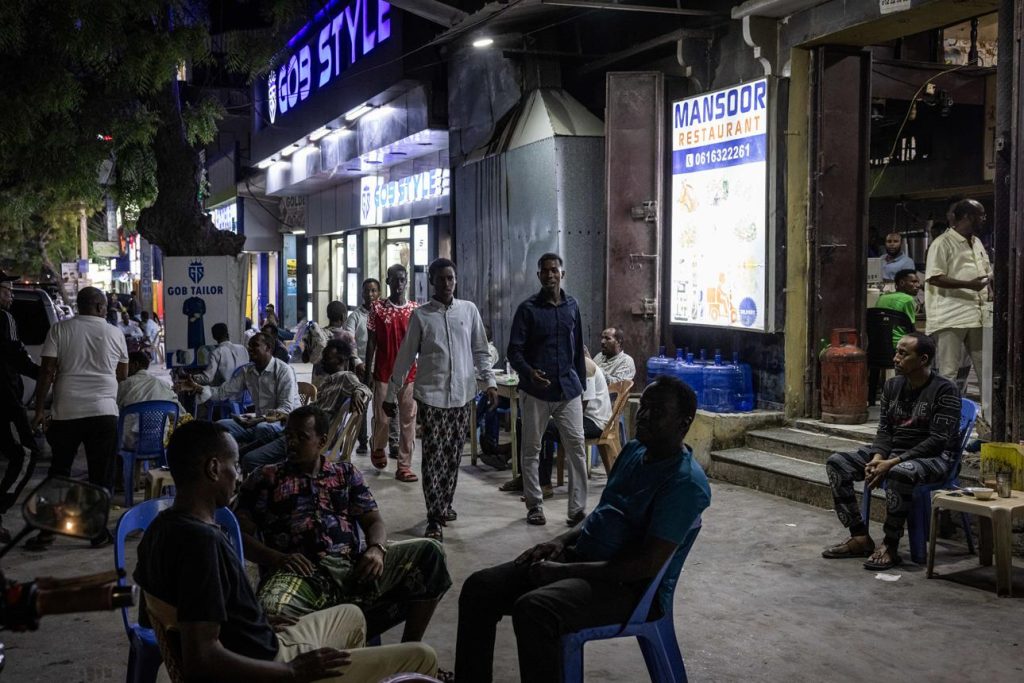
Gallup asked respondents whether they felt safe walking alone at night in the city or area where they live.
The question is intended to measure perceptions of everyday personal safety rather than a country’s overall security situation.
Gallup also uses questions about confidence in local police and respondents’ experiences of assault and theft to calculate its Law and Order Index.
Somalia recorded a score of 75 out of 100 on that index, compared with the global average of 80.
The report found that 69 percent of adults worldwide felt safe walking alone at night in 2025, a decline from 73 percent in 2024.
Important limitations to the findings
Despite the headline result, the survey’s coverage in Somalia presents an important limitation.
Security conditions prevented researchers from accessing areas representing approximately 29 percent of the country’s population. As a result, the findings reflect the experiences of people surveyed in accessible areas and may not capture the security perceptions of communities in areas excluded from the research.
The distinction is particularly important in a country where security conditions vary significantly between regions and districts.
The findings should therefore not be interpreted as a definitive ranking of Somalia’s overall security or as evidence that the country is safer than every nation with a lower percentage.
A different perspective on Somalia’s international image
The findings offer a perspective on how Somalia is often viewed internationally compared with how some residents experience their immediate communities.
Despite continuing security challenges, the survey suggests that many respondents feel relatively secure in their neighbourhoods and local surroundings.
Gallup’s broader analysis also found that people’s perceptions of personal safety were more consistently associated with national prosperity and homicide rates than the severity of armed conflict alone.
The report highlights the distinction between national security challenges and people’s everyday experiences of safety.
For Somalia, the result is notable, but it also underscores the importance of continued improvements in security, public confidence and the ability to conduct nationwide research that includes communities currently inaccessible to survey teams.