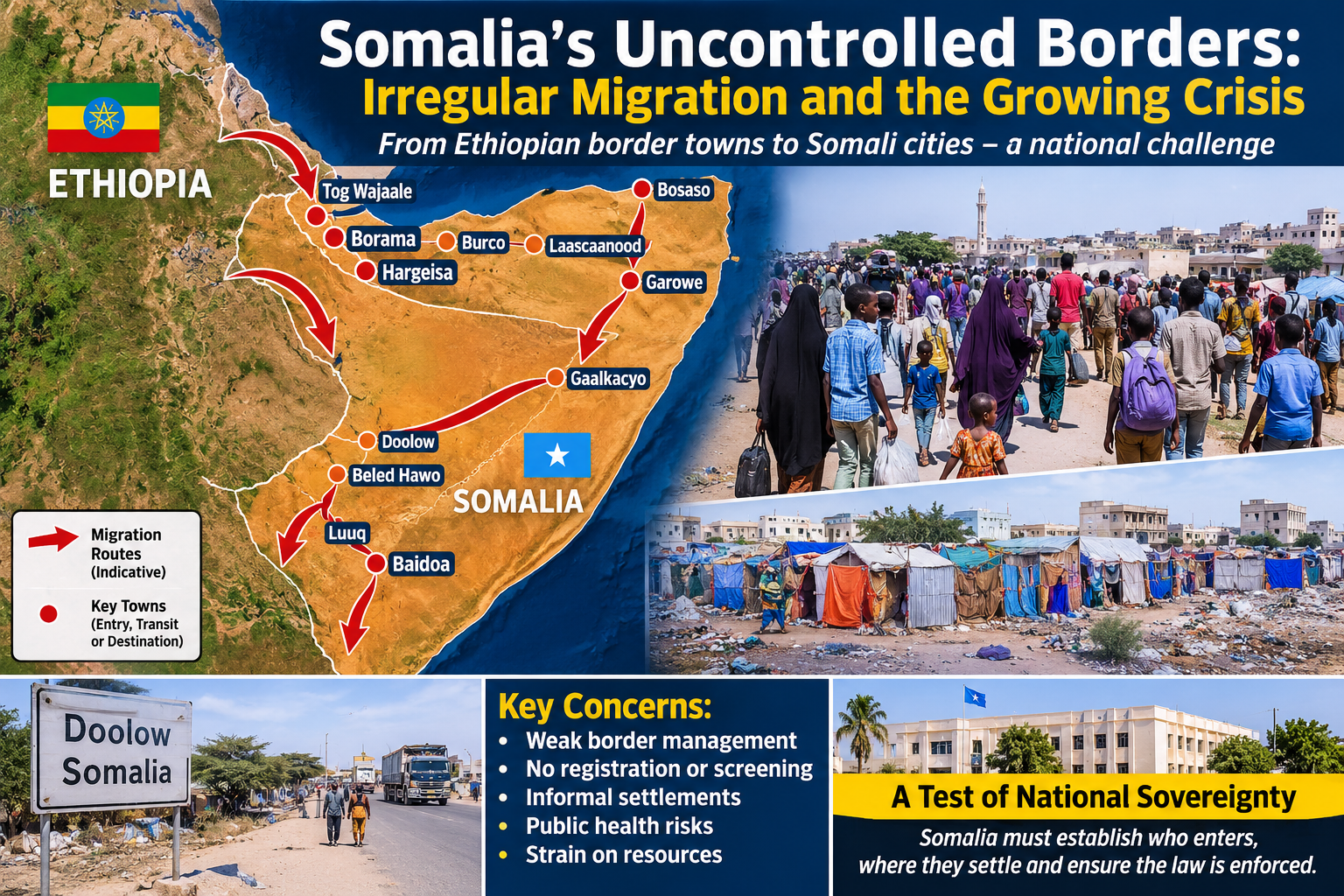
An investigation into irregular migration from Ethiopia, fragmented political authority and the unanswered questions facing Somalia’s immigration authorities.
By TheSomali.com Investigations Desk
Somalia’s immigration challenge does not end at the border. It continues along the roads connecting frontier towns to major cities, in the informal settlements emerging around urban centres, and in the gaps between the institutions responsible for controlling the movement of people.
In towns including Doolow, Beled Hawo and Borama, the movement of people across or near the Ethiopian border has become an increasingly important subject for local scrutiny. Further inland, Hargeisa, Burco, Garowe, Bosaso, Gaalkacyo, Baidoa and other urban centres feature in first-hand observations and reports of Ethiopian nationals arriving, seeking work, begging or living in makeshift accommodation.
The picture emerging from these observations raises a question that Somalia’s authorities have yet to answer publicly and comprehensively: who is responsible for knowing who enters the country, where they go and whether their presence is authorised?
The question is not whether Ethiopians should be allowed to travel to Somalia. The two countries share longstanding commercial, family and social connections. People cross borders for trade, employment, family reasons, travel and, in some circumstances, protection from danger. Their nationality alone says nothing about whether their presence is lawful.
The concern is whether Somalia has the systems to distinguish between these different circumstances, register people where required, identify those who may have entered or remained unlawfully, and prevent criminal networks from exploiting weaknesses in the country’s immigration system.
First-hand observations informing this investigation point to a pattern of movement from border areas towards larger towns and cities. They also raise concerns about informal settlements, begging, unauthorised occupation of land and inadequate sanitation in some locations. These observations require further documentation and responses from the relevant authorities. But they raise questions that cannot be dismissed as a minor administrative matter.
Somalia is attempting to rebuild a state after decades of conflict. Its ability to manage its borders is one of the clearest tests of whether its institutions can exercise authority beyond formal declarations.
The numbers: a migration corridor that cannot be ignored
The International Organization for Migration (IOM) has documented substantial movement through Somalia as part of the wider Eastern Migration Route, which connects the Horn of Africa with Yemen and the Gulf.
Its Displacement Tracking Matrix recorded 46,073 movements at seven monitoring points in Somalia during July 2026. Doolow accounted for 45 per cent of recorded incoming movements, Cabudwaaq for 20 per cent and Buuhoodle for 16 per cent. The monitoring points also included Lowyacado, Harirad, Dhobley and Bossaso.
These figures are significant, but they need to be understood correctly. IOM counts movements at selected monitoring points; it does not capture every person crossing Somalia’s borders. A recorded movement is not necessarily a unique individual, and the data does not establish that everyone recorded entered without authorisation.
The distinction is important. A country cannot determine immigration status through nationality or movement statistics alone. It requires registration, identity checks and procedures for establishing whether a person is a visitor, worker, resident, asylum seeker or someone in breach of immigration requirements.
The wider regional figures nevertheless point to growing pressure on migration-management institutions.
In its report covering January to March 2026, IOM recorded an 8 per cent increase in migration along the Eastern Route compared with the same period in 2025. Movements through Somalia increased by 189 per cent. IOM associated the increase with continued activity and expansion of smuggling and trafficking networks, as well as demand for onward movement towards Yemen and Saudi Arabia.
That 189 per cent figure does not mean Ethiopian arrivals into Somalia increased by 189 per cent. It refers to movements through Somalia along the wider Eastern Route. But it demonstrates the growing importance of Somali territory within a regional migration system.
The same report highlighted the human consequences. Stranded migrants in Somalia had nearly tripled compared with March 2025, while approximately 2,200 unaccompanied children were reported to be at heightened risk because of limited protection services.
For Somalia, these findings create two responsibilities. The government must manage entry and residence in accordance with its laws, and it must ensure that people vulnerable to exploitation are not abandoned or treated as criminals simply because they have travelled irregularly.
Following the movement: from border towns to urban centres
The geographical dimension is central to this investigation. It is not enough to identify places where people have been observed. The authorities and investigators need to establish how people arrive, which roads they use, where they stop and where they eventually settle.
The towns identified in the field reporting occupy different positions in this movement.
In the north-west, Borama and the Tog Wajaale corridor are relevant to cross-border movement, while Hargeisa and Burco are important urban locations for investigating onward travel and settlement. Earlier research by the Mixed Migration Centre has documented routes connecting Ethiopia, Tog Wajaale, Borama and Hargeisa, with some migrants continuing towards Bossaso and coastal departure points. These findings provide historical context, not proof that every current journey follows the same route.
Further east, Doolow and Beled Hawo are important locations for investigating movement across the Ethiopian border in the Gedo region. Luuq should be examined as a possible transit location, while Baidoa is among the southern cities identified in the field reporting.
In central and northern Somalia, the investigation includes Gaalkacyo, Garowe, Bosaso and Laascaanood. Their importance lies not simply in their location but in whether people arriving from other areas are moving there for employment, accommodation, onward travel or other reasons.
These towns should not be presented as a single chain of confirmed crossings. Some are border locations, others are urban destinations, and some may serve both purposes. The precise routes must be established through interviews with migrants, residents, transport operators and officials, supported by documentary evidence.
The geographical questions are straightforward:
- How many people enter through Doolow and Beled Hawo, and where do they travel afterwards?
- What is the scale of movement through Borama and the Tog Wajaale corridor?
- Are Hargeisa, Burco, Garowe and Bosaso receiving people who have travelled from these border areas?
- What routes connect Gedo’s border towns with other parts of Somalia?
- How many people remain in the towns where they arrive, and how many continue towards coastal departure points?
Without answers, Somalia is left with fragments of information rather than a national understanding of migration.
What is visible in the towns?
The first-hand observations informing this investigation identify a number of towns where Ethiopian nationals have been seen or reported to be present, including Hargeisa, Borama, Garowe, Bosaso, Laascaanood, Burco, Gaalkacyo, Baidoa, Luuq, Doolow and Beled Hawo.
The observations describe people moving from border areas towards larger urban centres. Some are reportedly begging or undertaking informal work. Others have been observed or reported living in makeshift accommodation, including shelters established on land whose ownership or permission for occupation has not been established.
These observations raise questions about the management of public spaces and the capacity of municipal authorities to respond to informal settlements.
Where shelters are established without adequate sanitation, waste disposal or access to basic services, local authorities face practical responsibilities. They must establish who controls the land, whether occupation is authorised, what sanitation arrangements exist and whether people living there require assistance or protection.
The issue is not simply how these settlements look. It is whether municipal authorities have the information, resources and legal powers to manage them.
There are also questions about local employment and informal economic activity. Are people working without the permits required by law? Are employers complying with labour and immigration requirements? Are intermediaries exploiting migrants by charging for accommodation, transport or employment?
These are matters that require investigation. Begging or informal work does not establish unlawful immigration status, and the presence of makeshift accommodation does not prove that everyone living there has entered the country illegally.
Nor can environmental problems be attributed to nationality. Poor sanitation is a matter for municipal management and public services. The authorities must address it through evidence-based measures that apply fairly to everyone.
The more fundamental concern is the apparent gap between what is visible in some towns and what is publicly known about the authorities’ response.
A state divided by political authority
Somalia’s immigration challenge is inseparable from its political structure.
The Federal Government has national responsibilities for immigration policy, border management and the country’s international obligations. Yet its ability to administer every part of the territory is constrained by political fragmentation, security conditions and the varying authority of regional administrations.
Puntland operates as a Federal Member State with its own administration and security institutions. Somaliland maintains a separate de facto administration and claims independence, although it is not internationally recognised as an independent state. Other areas have their own complex political and security arrangements.
This produces a difficult question: how does a national immigration policy operate when the institutions responsible for implementing it do not have the same operational reach across the country?
In practice, immigration management requires cooperation between the Federal Government and the authorities administering different territories. Border officials need to exchange information. Police need channels for referring suspected immigration offences. Municipal authorities need to know which agency is responsible for registration, enforcement and the protection of vulnerable people.
The first-hand concerns raised in this investigation make it necessary to examine whether such coordination is taking place in the towns identified.
What federal immigration personnel are deployed in each area? What role do regional authorities play? Are there functioning registration systems? Are the authorities sharing information about people moving between towns?
The situation should not be reduced to an assertion that one administration has complete control while another has none. The precise operational arrangements need to be established through official records and responses from each authority.
But political fragmentation cannot be allowed to create an accountability vacuum. If the Federal Government, regional administrations and municipal authorities each have responsibilities, the public is entitled to know what those responsibilities are and whether they are being fulfilled.
The government’s own documents raise questions
The Federal Government’s 2027 Budget Policy Framework Paper, published by the Ministry of Finance on 9 November 2026, provides an important starting point for assessing the government’s immigration programme.
The document reports that the Immigration and Citizenship Agency has established 17 new points of entry across Somalia. It also records that 2,327,888 people were facilitated at border points during 2026.
But the same document identifies a significant operational issue. Immigration Border Management Committees have been established in Mogadishu and regional capitals, yet their operationalisation remains pending, with the exception of the committee in Mogadishu.
This raises a question that goes beyond the number of border posts established: how much of the new infrastructure is functioning as an integrated national system?
A point of entry is not effective simply because it appears in a government report. It requires trained personnel, functioning equipment, reliable identity checks, access to databases, clear procedures and the ability to communicate with other agencies.
Similarly, establishing a committee does not demonstrate that it is meeting regularly, sharing information or coordinating enforcement.
The government’s own policy document therefore presents a distinction between institutional establishment and operational effectiveness.
The Immigration and Citizenship Agency’s published mandate includes border controls, the issuance of travel and residence documents, and the registration of refugees and asylum seekers.
The question is whether the agency has the personnel, resources and working relationships necessary to fulfil those responsibilities across the country.
The government should explain how the 17 new points of entry operate, which are staffed, what information they collect and how records are shared. It should also publish details of the border committees: their membership, operational status, meeting records and work programmes.
These are measurable questions. They should be answered with documents and figures rather than general assurances.
Who is counting those who enter and remain?
One of the most important gaps in the public debate is the absence of a comprehensive, publicly available national picture of foreign nationals residing in Somalia.
There is a difference between counting people who pass through a monitoring point and establishing how many foreign nationals live in a particular town. There is also a difference between recording a person’s nationality and establishing their immigration status.
The authorities should be able to answer basic questions:
How many foreign nationals are registered as residents? How many hold valid work permits? How many are visitors or in transit? How many have sought asylum? How many have been identified as having entered or remained without the required authorisation?
The same questions should be asked at municipal level. If local authorities are receiving complaints about informal settlements or people living in public spaces, what records do they maintain? Have immigration officials been notified? Have assessments been carried out?
The absence of a comprehensive public register does not prove that no government agency collects information. It does, however, make it difficult for parliament, journalists and the public to assess the scale of the challenge or the effectiveness of government action.
There are also legitimate public-health and service-planning questions. Authorities need to understand the health and welfare needs of people arriving in their jurisdictions, just as they need to plan for local residents. Appropriate screening and access to services should be non-discriminatory. The absence of reliable information is not evidence that migrants pose a health risk; it is evidence that better information and public-service planning are needed.
The business of moving people
The role of intermediaries is another part of the investigation that requires attention.
People moving across borders may rely on drivers, transport operators, guides, brokers or other intermediaries. Some journeys are legitimate. Others may involve people being charged to facilitate irregular entry or onward travel.
IOM’s regional reporting identifies the continued operation and expansion of smuggling and trafficking networks as factors associated with increased movement along the Eastern Route.
For Somalia, the question is whether individuals or organised networks are facilitating movement through its territory, how they operate and whether the authorities are investigating them.
Investigators should establish who arranges transport, who receives payments, which routes are used, where people are accommodated and whether migrants face extortion, violence or exploitation.
It is important to distinguish migrant smuggling from human trafficking. Smuggling generally involves facilitating irregular movement for financial or material benefit. Trafficking involves exploitation and has additional legal elements. A person who has entered irregularly is not automatically a trafficking victim, but may be vulnerable to exploitation.
The authorities should focus on the people organising and profiting from criminal activity, while ensuring that vulnerable migrants can access protection and appropriate legal procedures.
This investigation has not established the identities or structure of any specific smuggling network. Those claims require evidence, named incidents and official investigations. But the regional evidence makes the issue too important to leave unexplored.
The questions government must answer
The Federal Government, Puntland, Somaliland authorities and the municipal administrations identified in this investigation should be asked to respond to a common set of questions.
The Federal Government and Immigration and Citizenship Agency
- How many foreign nationals are currently registered as residents in Somalia?
- How many foreign nationals hold valid residence or work permits?
- What information is available on Ethiopian nationals entering and residing in the country?
- Which of the 17 newly established points of entry are fully operational?
- Why are Immigration Border Management Committees outside Mogadishu still awaiting operationalisation, as stated in the 2027 Budget Policy Framework Paper?
- How many investigations into suspected migrant smuggling and human trafficking have been opened?
- What arrangements exist for sharing immigration data with regional and municipal authorities?
Puntland authorities
- What immigration registration and monitoring arrangements operate at land and coastal entry points?
- What records are maintained on foreign nationals entering, working or residing in Puntland?
- How are suspected irregular entry and residence cases investigated?
- What coordination exists with the Federal Government’s Immigration and Citizenship Agency?
Somaliland authorities
- What procedures operate at Ethiopia-facing crossings and in major towns?
- How many foreign nationals are registered or documented?
- What action is taken when people are found to be living or working without the required authorisation?
- What systems exist to investigate suspected smuggling and protect vulnerable migrants?
Municipal authorities
- Have complaints been received about informal settlements or unauthorised occupation of land?
- What assessments have been carried out in the locations identified by this investigation?
- What measures have been taken to address sanitation and public-space management?
- Have local authorities referred immigration concerns to the relevant agencies?
- What support do municipalities receive from regional and federal institutions?
These questions should be put formally to the relevant offices. Their responses, including any refusal to comment or failure to respond by the publication deadline, should be recorded in the final investigation.
Enforcement without collective blame
A stronger immigration system does not require hostility towards Ethiopian nationals or any other foreign community.
Somalia has a legitimate interest in controlling entry, regulating residence, enforcing work-permit requirements and investigating suspected criminal activity. But those responsibilities must be exercised according to the law.
People may have entered through recognised crossings, travelled without conventional documents, sought asylum or become stranded while attempting to reach another country. Their circumstances cannot be determined by appearance, language or nationality.
The authorities must establish each person’s legal position through appropriate procedures. People seeking international protection must have access to the relevant process. Victims of trafficking and exploitation must be protected, not treated simply as immigration offenders.
A functioning system should be firm where immigration law has been breached, effective against criminal networks and fair towards people whose circumstances require protection.
The cost of leaving the questions unanswered
The issue is ultimately about more than migration statistics.
When local authorities cannot establish who is living in their jurisdictions, they struggle to plan services, manage land and public spaces and identify people who may need protection. When immigration agencies cannot share information across administrative boundaries, enforcement becomes inconsistent. When criminal networks exploit gaps between institutions, both migrants and local communities can suffer.
Somalia’s political leaders have repeatedly emphasised sovereignty and territorial integrity. But sovereignty also has an administrative meaning. It requires institutions capable of implementing laws, maintaining reliable records and coordinating public responsibilities across the territory.
The government’s own budget framework acknowledges both progress in establishing immigration infrastructure and unfinished work in making coordination mechanisms operational. IOM’s monitoring shows that Somalia remains an important part of a changing regional migration corridor. First-hand observations in towns identified by this investigation raise further questions about what happens after people arrive.
Taken together, these issues demand a public explanation.
The government must show how the border posts operate, how regional authorities coordinate with federal agencies, what is known about foreign-national residence and what action is being taken where immigration violations are established.
The question facing Somalia is not whether migration will continue. It will. The question is whether the state can manage it.
Who is monitoring the movement of people across Somalia, who is accountable when the system fails, and when will the government provide the public with verifiable answers?
Until those questions are answered, the country’s immigration system will remain an important test of its institutional capacity, political coordination and commitment to national sovereignty.