Garissa, Kenya — For decades, infrastructure in Kenya’s Somali-dominated north eastern counties has lagged behind the country’s more developed regions, leaving communities facing poorer roads, ageing bridges and limited connectivity to national markets.
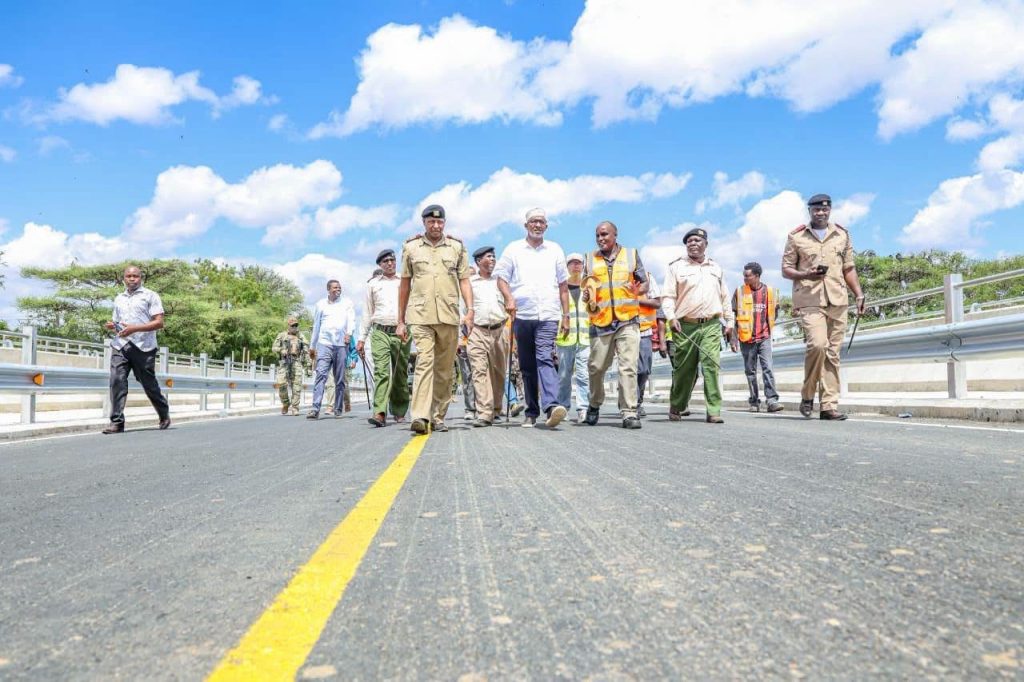
That gap is now becoming a central part of the development conversation as the government highlights a series of major infrastructure projects in Garissa County.
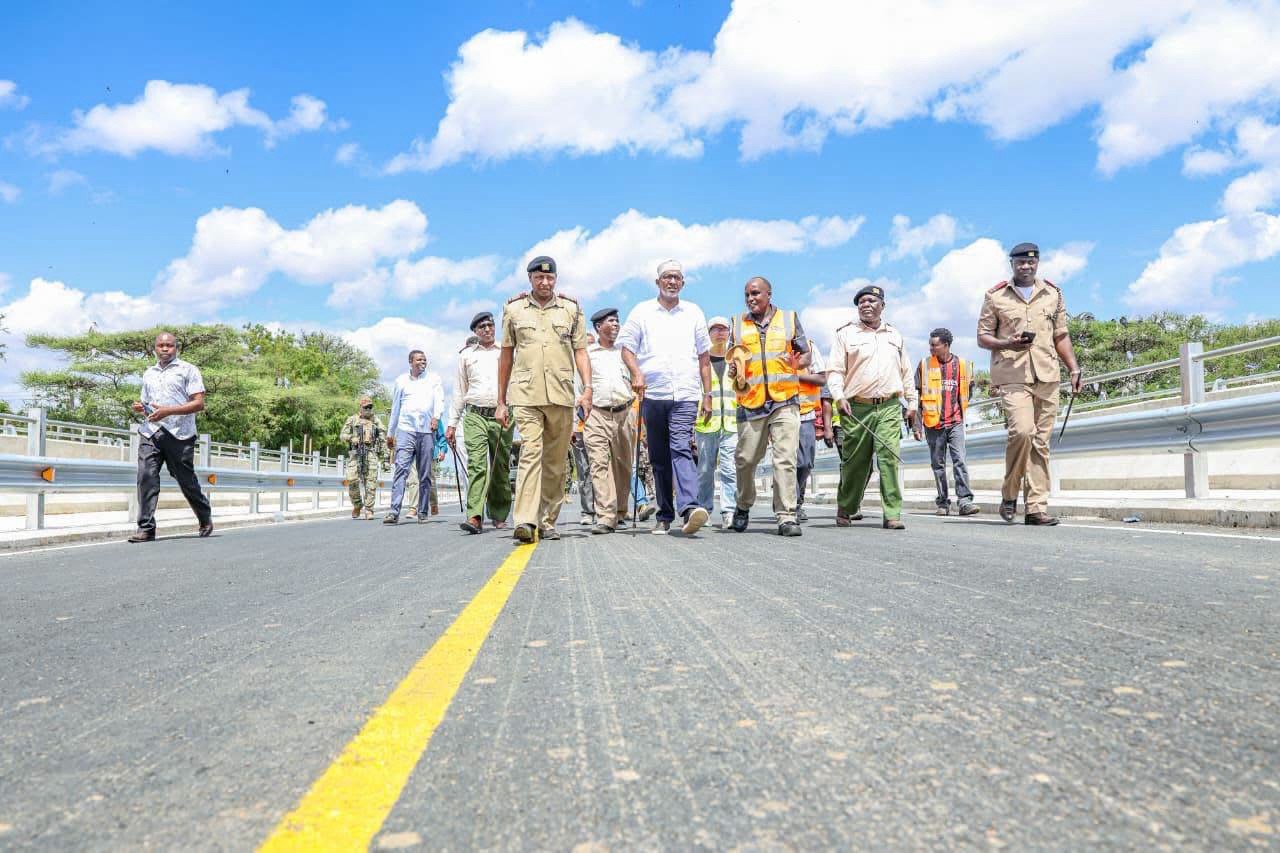
During a development tour of Garissa over the weekend, senior government officials inspected national projects involving affordable housing and transport infrastructure, including a newly completed bridge over the Tana River and a 407-unit affordable housing development.
The projects are being presented by the government as part of President William Ruto’s Bottom-Up Economic Transformation Agenda and its wider commitment to spreading public investment across the country.
But in North Eastern Kenya, infrastructure carries a significance that goes beyond individual projects.
It is closely connected to a much older question of equity.
A region that has waited for connectivity
Garissa is one of the main urban and economic centres of North Eastern Kenya. Yet for many years, the region’s infrastructure has struggled to keep pace with the needs of a growing population and economy.
Long distances between towns, periodic flooding, inadequate transport links and the condition of older infrastructure have increased the cost of moving people and goods.
For communities dependent on livestock, agriculture, trade and cross-border commerce, reliable transport infrastructure is not simply about convenience.
It determines whether farmers can reach markets, whether businesses can move goods efficiently and whether residents can access education, healthcare and government services.
The question facing North Eastern Kenya has therefore increasingly been: when will infrastructure investment catch up with the region’s contribution and needs?
A new bridge replacing 43-year-old infrastructure
One of the most significant projects inspected in Garissa is the newly completed 150-metre Garissa–Tana River Bridge.
The government says the KSh1.8bn bridge forms part of the Ukasi–Garissa–Modika corridor and replaces an ageing structure that had served the region for 43 years.
Its significance is particularly clear during periods of heavy rainfall and flooding, when transport links in parts of North Eastern Kenya can become vulnerable.
A flood-resistant bridge can provide more reliable movement along an important transport corridor, reducing disruption for residents, traders and commercial vehicles.
For Garissa, that means connectivity.
For North Eastern Kenya, it represents something larger: an investment in infrastructure that connects a historically underserved region more effectively to the rest of the country.
Why roads matter more in North Eastern Kenya
Infrastructure needs in North Eastern Kenya cannot be assessed using exactly the same assumptions applied to densely populated parts of central and western Kenya.
The region is vast, communities are widely dispersed and distances between major population centres can be substantial.
That makes transport infrastructure particularly important.
A kilometre of reliable road in a densely populated area can serve thousands of people living nearby.
In the north east, infrastructure often has to connect communities separated by much greater distances.
The economic return is therefore not simply measured by traffic volumes.
A road can determine whether a remote community is connected to a county headquarters, whether livestock can reach markets before losing value, or whether a child can reliably travel to school.
This is why infrastructure investment in Garissa, Wajir and Mandera should be viewed partly through the lens of regional equity.
Housing adds another dimension
The 407 affordable housing units being developed in Garissa represent another aspect of the same development challenge.
Kenya’s affordable housing programme has largely been discussed through the lens of the country’s housing shortage and urbanisation.
But its relevance in North Eastern Kenya is also connected to the development of towns that increasingly serve as commercial and administrative centres.
The government says the Garissa development is approaching completion and is expected to be commissioned by President Ruto in December.
If completed and occupied as planned, the project would add formal housing stock to a city where population growth and economic activity are increasing.
Correcting a historical imbalance?
The development push raises a broader question about Kenya’s model of national development.
For much of the country’s post-independence history, infrastructure investment has been concentrated around the economic corridors that connect Nairobi with the coast and the country’s agricultural heartlands.
North Eastern Kenya has often been treated differently.
Its history of marginalisation is well documented, and the region has experienced lower levels of infrastructure and public services than many other parts of the country.
The result is a development gap that cannot be closed by one bridge or one housing project.
It requires sustained investment over many years.
That means roads.
It means bridges.
It means water.
It means electricity.
It means telecommunications.
And it means connecting northern towns to the national and regional economy.
Infrastructure as an economic investment
There is also a strong economic argument for changing the way North Eastern Kenya is connected.
Garissa’s location gives it potential importance as a gateway between Kenya’s interior and the wider Horn of Africa.
Better roads can reduce transport costs and make it easier for businesses to operate.
Improved connectivity can also support livestock markets, agricultural production, logistics and trade.
For a region bordering Somalia and located within the wider East African and Horn of Africa trading environment, infrastructure can become an economic asset rather than simply a public service.
The challenge is turning physical infrastructure into economic opportunity.
That will require investment beyond construction — including reliable electricity, water, digital connectivity, finance, education and support for local businesses.
The politics of inclusion
For residents of North Eastern Kenya, the significance of these projects is also political.
Development is ultimately about whether citizens believe that the state is investing in their communities on an equal basis.
The construction of a modern bridge replacing a structure that has served the region for more than four decades sends a visible message about public investment.
But residents will judge the broader development agenda by what comes next.
One bridge cannot erase decades of infrastructure deficits.
One housing project cannot solve the region’s housing needs.
The real measure will be whether investment continues across the north east — and whether Garissa, Wajir and Mandera receive infrastructure capable of supporting the economic potential of their populations.
North Eastern Kenya deserves more than catch-up development
The region should not have to argue indefinitely for the same infrastructure that other parts of Kenya have taken for granted.
North Eastern Kenya is part of Kenya’s economy, its security architecture and its future.
Its strategic location also gives the country an opportunity to build stronger economic links with the wider Horn of Africa.
The current government’s emphasis on projects in Garissa therefore matters beyond the individual developments being constructed.
It raises the possibility of a broader shift: from viewing North Eastern Kenya primarily through security and marginalisation to recognising it as a region requiring — and capable of generating — sustained economic investment.
The Garissa–Tana River Bridge is one piece of that puzzle.
The affordable housing project is another.
But the bigger task is clear.
North Eastern Kenya does not simply need development projects. It needs decades of accumulated infrastructure inequality to be systematically addressed.
If the government can sustain investment in roads, bridges, housing and connectivity across the region, the impact could extend beyond Garissa — strengthening trade, mobility and economic integration across one of Kenya’s historically underserved regions.
For communities that have waited generations for comparable infrastructure investment, equity is not a political slogan. It is the expectation that development should finally reach them too.