President Hassan Sheikh Mohamud’s meeting with Uganda’s Yoweri Museveni highlights a complicated relationship built on nearly two decades of military cooperation, but also marked by political criticism, controversial statements from Uganda’s military chief and Kampala’s growing defence ties with Israel. For Mogadishu, the challenge is to recognise Uganda’s contribution without overlooking the wider geopolitical implications.
ENTEBBE, November 23, 2026
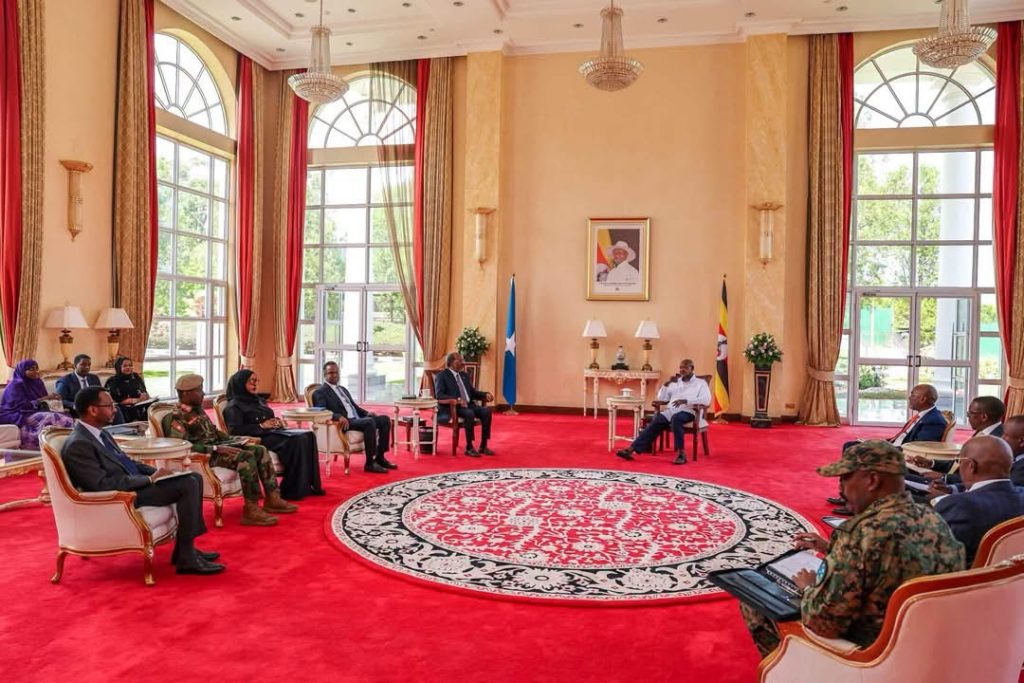
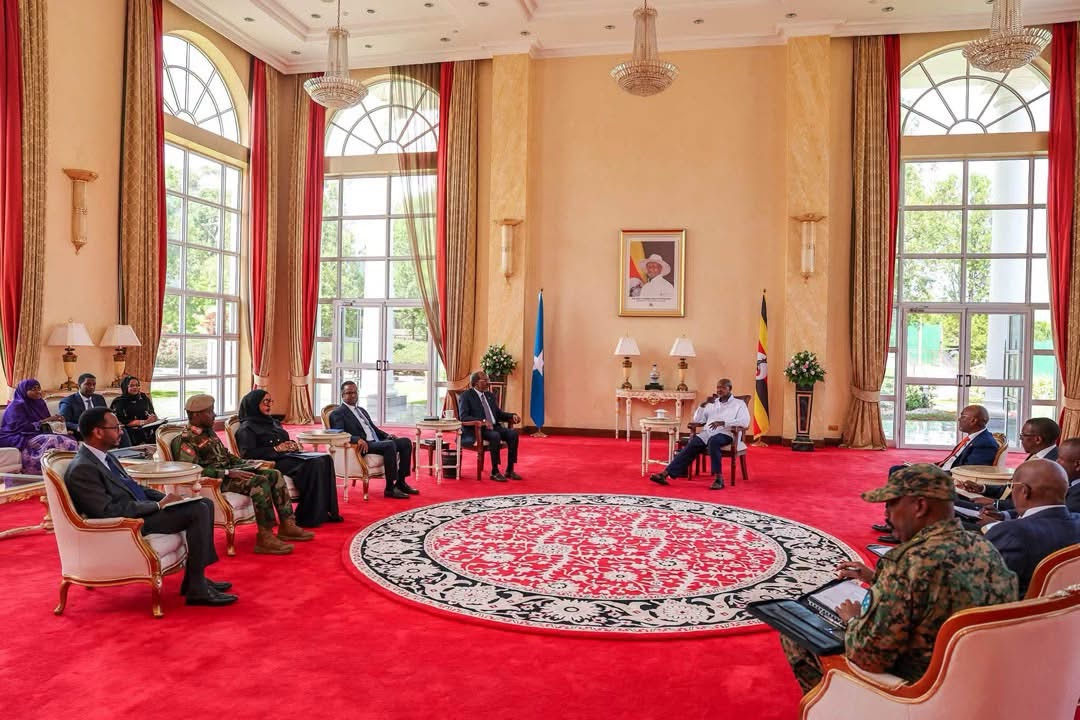
When Somali President Hassan Sheikh Mohamud travelled to Uganda on Monday for talks with President Yoweri Kaguta Museveni, the two governments presented a familiar picture of African solidarity: longstanding military cooperation, shared security concerns and renewed commitments to economic partnership.
The joint communiqué praised Uganda’s contribution to Somalia’s security since 2007, called for sustainable financing of the African Union Support and Stabilization Mission in Somalia (AUSSOM) and outlined plans to expand trade, aviation and labour cooperation.
Yet the relationship between the two countries is more complicated than the diplomatic language suggests.
Museveni has previously made remarks about Somalia that provoked considerable criticism among Somalis. His son, General Muhoozi Kainerugaba, Uganda’s military chief, has repeatedly used social media to make controversial statements about the country’s military involvement in Somalia, the cost of the deployment and the role of other international partners.
At the same time, Uganda has maintained a close defence relationship with Israel, a country whose recognition of Somaliland in December 2025 created a major diplomatic confrontation with Mogadishu.
These issues do not negate Uganda’s contribution to Somalia’s security. They do, however, raise questions about the political assumptions underpinning a relationship that has become increasingly important to both governments.
Museveni and Somalia: From criticism to diplomatic partnership
Museveni’s relationship with Somalia has not always been characterised by the language of solidarity heard in Entebbe.
In January 2019, the Ugandan president attracted criticism from Somalis after using Somalia as an example of a country without organised state authority during remarks at a judicial conference in Kampala.
His comments touched a sensitive historical nerve. Somalia had previously enjoyed functioning state institutions and had played a role in regional affairs before the collapse of its central government in 1991.
For many Somalis, the remarks appeared to overlook the country’s history and the devastating consequences of state collapse, civil war and foreign intervention.
Museveni also questioned the effectiveness of the international mission in Somalia. In 2016, he argued that Uganda’s original purpose in deploying troops had been to help Somalis establish their own army, questioning why substantial progress had not been achieved after nine years of military involvement.
His criticism was not entirely directed at Somalia’s population or its statehood. Much of it concerned the international approach to security assistance, the failure to build effective Somali institutions and the continued dependence on foreign troops.
That distinction is important.
Museveni’s military involvement in Somalia began in 2007, when Uganda became the first country to deploy troops under the African Union mission. His government has consistently presented the intervention as a contribution to regional security and opposition to violent extremism.
His visit to Mogadishu in September 2016 also illustrated this dual relationship. Museveni travelled to Somalia to attend an extraordinary IGAD summit hosted by then-President Hassan Sheikh Mohamud. During the visit, he also spent time at the Ugandan military base in Halane, meeting commanders and soldiers serving under AMISOM.
His presence was therefore both diplomatic and military: participation in regional discussions and direct engagement with Ugandan forces operating in Somalia.
In August 2026, Museveni again defended Uganda’s intervention, telling an extraordinary AUSSOM summit in Kampala that his country’s decision to deploy troops had been based on principle and strategic necessity, despite Uganda not sharing a border with Somalia.
The contrast between his earlier criticism and his subsequent expressions of solidarity illustrates a relationship shaped by both strategic interests and political disagreements.
Muhoozi Kainerugaba and the politics of Uganda’s military presence
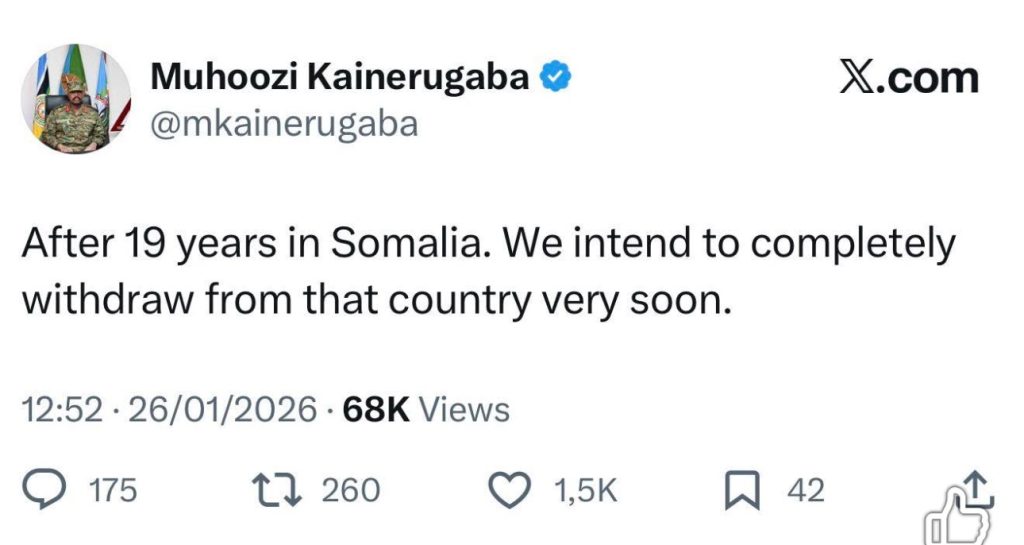
The most unpredictable element of the relationship has arguably been General Muhoozi Kainerugaba.
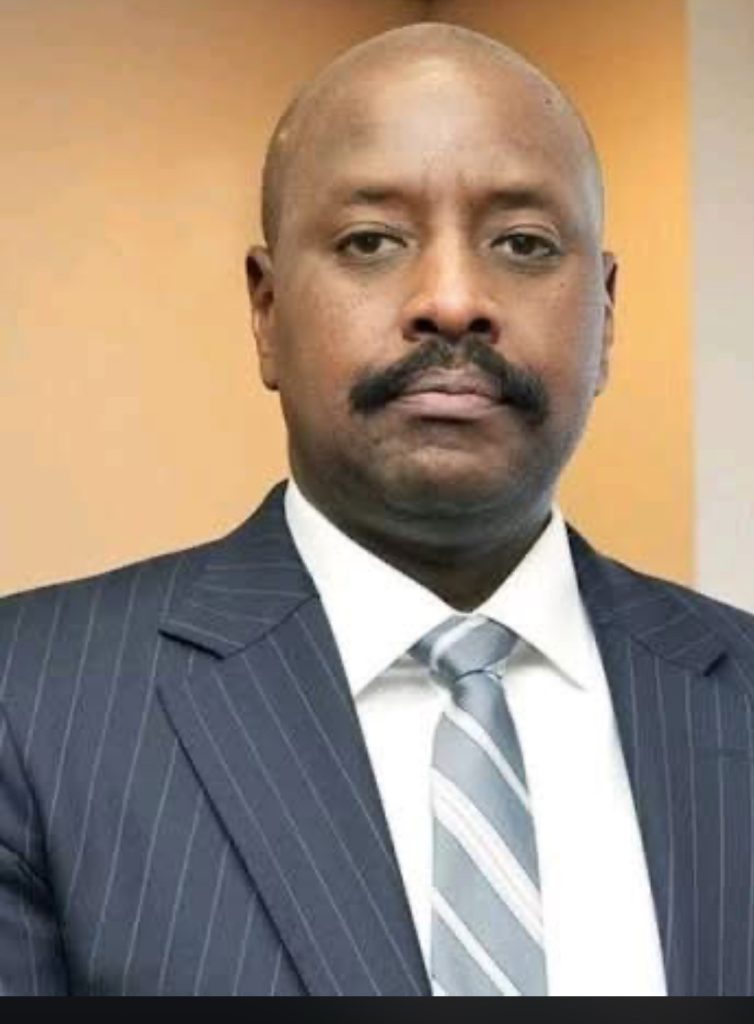
As Uganda’s Chief of Defence Forces and Museveni’s son, Muhoozi occupies a position of considerable influence in the country’s security establishment. His public statements therefore attract attention beyond ordinary social-media commentary.
His remarks about Somalia have repeatedly focused on Uganda’s military sacrifices and what he considers inadequate recognition and compensation.
In July 2023, following Ugandan military operations against Al-Shabaab, Muhoozi complained that Uganda was doing much of the heavy lifting while other international actors received recognition.
He also warned that Uganda could eventually withdraw its forces, questioning what would happen to Somalia’s security arrangements without the Ugandan military contribution.
In August 2024, he escalated his demands, calling for substantial compensation from the United States for Uganda’s military losses in Somalia.
In early 2026, he announced an intention to withdraw Ugandan troops after nearly two decades of involvement. His statements were followed by renewed debate over the financial burden of the deployment and the future of Uganda’s participation in the African Union mission.
In April 2026, his criticism shifted towards Türkiye. He demanded $1 billion and made an inappropriate personal demand in connection with Uganda’s contribution to the fight against Al-Shabaab. The remarks were subsequently deleted and Kampala sought to clarify that they reflected grievances rather than official Ugandan foreign policy.
The underlying issue was nevertheless significant.
Uganda believes its soldiers have borne considerable costs in securing Mogadishu and fighting Al-Shabaab, while other international partners have expanded their commercial and strategic involvement in Somalia.
That argument deserves examination. Uganda’s military sacrifices are real, and its contribution should not be dismissed.
But Somalia is a sovereign country, not an investment or security arrangement through which foreign military actors acquire permanent political claims.
Uganda’s military contribution should be recognised through formal diplomatic and institutional arrangements, not through public statements that risk undermining confidence between the two countries.
There is also a distinction between the president’s official foreign policy and his son’s public rhetoric. Museveni should not automatically be held responsible for every statement made by Muhoozi, but the general’s position within Uganda’s military establishment means that his comments cannot simply be treated as those of an ordinary social-media user.
The latest developments make this particularly relevant. Uganda began withdrawing troops from Somalia in October 2026, but the November communiqué now calls for alternative financing arrangements to sustain its bilateral military deployment.
The document does not establish whether the withdrawal will be reversed. It does, however, reveal that both governments recognise the importance of resolving the financial question.
Uganda, Israel and the implications for Somalia
Perhaps the most sensitive dimension of Uganda’s regional relationships is its longstanding strategic partnership with Israel.
Uganda and Israel have maintained diplomatic relations for decades, notwithstanding periods of interruption. Their relationship has included military cooperation, intelligence, agricultural development and technological exchange.
The historical connection is particularly significant because of the 1976 Entebbe hostage-rescue operation, in which Israeli forces carried out a military raid at Entebbe airport to free hostages held aboard an aircraft.
Relations subsequently recovered, and the two governments have developed closer security cooperation.
In September 2022, Uganda and Israel signed a memorandum of understanding on defence cooperation. Uganda’s Ministry of Defence said the agreement covered security, military training, intelligence, air defence and technological cooperation.
The relationship has also continued through high-level military engagement. In 2026, Uganda’s military chief met Israel’s newly appointed ambassador, with both sides describing their relationship as strong.
For Uganda, Israel offers defence technology, military expertise and security cooperation. For Israel, Uganda is an important East African partner with strategic geographical access to the wider region.
But the relationship has acquired a new significance for Somalia following Israel’s recognition of Somaliland.
On December 26, 2025, Israel formally recognised Somaliland as an independent state, becoming the first country to do so. The decision was condemned by Somalia’s Federal Government, which considers Somaliland part of its sovereign territory.
Israeli Foreign Minister Gideon Sa’ar subsequently visited Hargeisa in January 2026, reinforcing the new relationship.
Israel’s engagement with Somaliland has wider strategic implications. Somaliland’s location along the Gulf of Aden, its proximity to the Red Sea and its position near important international shipping routes make it relevant to Israeli security and commercial interests.
The UAE’s substantial investment in Berbera port has added another dimension to this regional picture.
For Mogadishu, the concern is not simply that Israel has established relations with Somaliland. It is that external security and economic partnerships could develop in ways that weaken Somalia’s territorial integrity or bypass its internationally recognised federal institutions.
This is where Uganda’s relationship with Israel becomes relevant.
There is no established evidence that Uganda has endorsed Israel’s recognition of Somaliland or participated in any Israeli strategy concerning Somali territory. Its defence cooperation with Israel should not be confused with proof of involvement in Israel’s Somaliland policy.
Nevertheless, Mogadishu has a legitimate interest in understanding how its security partners relate to other governments whose actions directly affect Somalia’s sovereignty.
Uganda cannot be expected to abandon its independent diplomatic relationships. Equally, Somalia should not ignore the potential implications of those relationships.
The appropriate response is diplomatic clarity: Uganda should respect Somalia’s internationally recognised territorial integrity, while Mogadishu should communicate its concerns directly and consistently.
The contradiction at the centre of the Entebbe meeting
The November 23 communiqué presents an interesting contradiction.
On one hand, Somalia praises Uganda for nearly two decades of military sacrifice. On the other, Uganda is seeking alternative financing for its bilateral forces while withdrawing troops from the country.
The two governments also want to expand economic cooperation, including a Ugandan trade warehouse in Mogadishu, a proposed port facility, a bilateral labour agreement and improved air services.
These are significant ambitions, but they require trust.
Somalia cannot build a stable foreign policy around military dependence alone. Nor can Uganda expect its commercial and security interests to be protected without respecting the political independence of its Somali partner.
The relationship must move towards a more balanced arrangement in which military cooperation is governed by clear agreements, economic engagement benefits both countries and diplomatic disagreements are handled through established channels.
The Somali government should also seek clarification on the position of its international partners regarding Israel’s recognition of Somaliland. This is particularly important when those partners maintain defence relationships with Israel.
Such engagement need not become a confrontation. It is a necessary part of protecting national interests.
Somalia needs partners, but it must define the terms
Somalia’s relationship with Uganda demonstrates the complexity of its international partnerships.
Uganda has played an important role in helping protect Mogadishu and supporting successive African Union missions. Its soldiers have suffered casualties, and its contribution to the fight against Al-Shabaab deserves recognition.
But gratitude should not become a substitute for independent foreign policy.
Somalia must be able to appreciate Uganda’s military contribution while addressing political disagreements, rejecting inappropriate external interference and defending its territorial integrity.
The same principle should apply to all international partners, whether they are from the Gulf, Africa, Europe or the wider Middle East.
The next phase of relations between Mogadishu and Kampala should therefore be based on three principles: respect for sovereignty, transparent security cooperation and economic partnerships that produce measurable benefits.
Museveni’s expected visit to Somalia, following President Hassan Sheikh’s invitation, will provide another opportunity to address these questions.
The meeting in Entebbe was an important diplomatic engagement. But the deeper test will be whether the two countries can build a relationship in which military sacrifice, political respect and economic cooperation reinforce one another.
Somalia needs reliable partners in its struggle against Al-Shabaab. It also needs partners who understand that supporting Somalia’s security means respecting Somalia’s sovereignty.